
Understanding Food Ingredients: Why Functionality Matters

- 2026-10-07
- Keya Chem Corporation
Understanding Food Ingredients: Why Functionality Matters
How functional food ingredients influence texture, viscosity, stability, processing, and overall product performance
Quick Answer
What Does Functionality Mean in Food Ingredients?
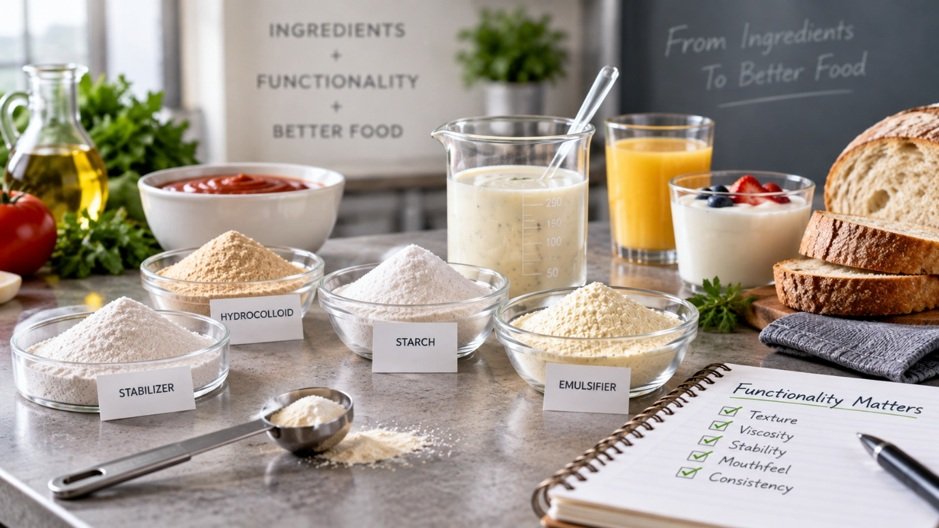
Functionality refers to what a food ingredient does within a formulation and how it contributes to the desired characteristics of the finished product.
A functional ingredient may help control texture, viscosity, suspension, moisture distribution, structure, consistency, or physical stability, depending on the ingredient, grade, concentration, processing conditions, and overall formulation.
This is why food manufacturers do not select ingredients only by their names. The right ingredient is selected based on the function required in the specific food application.
For example, ingredients such as Xanthan Gum, Guar Gum, Carrageenan, Pectin, Carboxymethyl Cellulose (CMC), Locust Bean Gum, and starches can provide different functional properties in different food systems.
Introduction: Why Food Ingredient Functionality Matters
Modern food products are expected to deliver consistent texture, appearance, viscosity, quality, and stability throughout their intended shelf life.
However, food formulations are complex systems. Ingredients interact with one another, and the product may experience mixing, heating, cooling, transportation, and storage before it reaches the consumer.
These conditions can affect properties such as texture, moisture distribution, viscosity, suspension, and physical stability. Functional food ingredients help manufacturers manage these characteristics and achieve the desired product performance.
This is why ingredient functionality matters.
The important question is not simply:
“What ingredient should I use?”
It is:
“What function does my formulation need?”
Once that requirement is clear, ingredient selection becomes more application-focused.
What Is Food Ingredient Functionality?
Food ingredient functionality describes the specific role an ingredient performs within a food formulation.
The same ingredient can contribute to different properties depending on the food system, concentration, processing conditions, and other ingredients present.
Functional requirements may include:
- Texture
- Viscosity
- Suspension
- Stability
- Moisture management
- Structure
- Consistency
- Processing performance
For example, a hydrocolloid may interact with water and modify the physical properties of a food system. Increasing viscosity can influence how ingredients move through the product and help maintain a more uniform structure.
The key point: an ingredient should be evaluated according to the function it performs in the complete formulation, rather than by one property alone.
Why Is Functionality More Important Than Ingredient Names?
Two ingredients may appear similar but perform differently in a particular formulation.
Likewise, one ingredient may perform more than one function.
For example:
- Xanthan Gum can provide viscosity while also supporting suspension and consistency.
- Guar Gum can provide strong thickening while contributing to texture and physical stability.
This means that ingredient selection should be based on the required product outcome, not simply on choosing the ingredient known for the highest thickening ability.
A useful way to think about ingredient selection is:
Application → Required Function → Ingredient Selection → Processing → Final Product Performance
This application-focused approach is particularly important when developing products with specific texture, viscosity, stability, or processing requirements.
What Are Functional Food Ingredients?
Functional food ingredients are ingredients selected because they provide a specific technological or physical function within a food formulation.
Depending on the application, functional ingredients may help manufacturers achieve the following:
Control Texture : Ingredients can contribute to smooth, creamy, thick, or structured textures.
Control Viscosity : Some ingredients help determine how thick or fluid a product becomes.
Improve Suspension : Certain ingredients can help keep particles or other components more evenly distributed.
Support Stability : Stabilizing ingredients can help maintain desired physical properties during processing and storage.
Manage Moisture : Some hydrocolloid-based ingredients can influence water availability and moisture distribution.
Improve Consistency : Functional ingredients can contribute to maintaining similar product characteristics when the formulation and manufacturing process are properly controlled.
Hydrocolloids: An Important Group of Functional Ingredients
Many commonly used food stabilizers are hydrocolloids.
Hydrocolloids interact with water and can modify the physical properties of a food system. Depending on their characteristics, they may influence viscosity, texture, suspension, separation, moisture distribution, and physical stability.
Common examples include:
- Xanthan Gum
- Guar Gum
- Carrageenan
- Pectin
- Carboxymethyl Cellulose (CMC)
- Locust Bean Gum
Starches can also provide important functional properties such as thickening, structure, and texture.
However, functionality depends on the specific grade, concentration, processing conditions, and overall formulation.
Key Functional Roles of Food Ingredients
Functional Requirement | What It Means in a Food Formulation |
Viscosity | Controls how thick or fluid the product is |
Texture | Influences mouthfeel and physical structure |
Suspension | Helps maintain more uniform distribution of certain components |
Stability | Helps maintain desired physical properties over time |
Moisture Management | Influences water distribution and availability |
Consistency | Helps maintain similar product characteristics |
Processing Performance | Supports suitable behavior during manufacturing |
Storage Stability | Helps maintain desired characteristics during storage |
The appropriate balance depends on the specific product and formulation requirements.
How Do Processing Conditions Affect Ingredient Functionality?
An ingredient does not work in isolation.
Its performance can be influenced by:
Water Availability → Concentration → Temperature → pH → Shear → Ingredient Interactions
This explains why an ingredient that performs well in one food application may behave differently in another.
Water Availability : Hydration conditions are particularly important for hydrocolloid-based ingredients.
Concentration : The amount of an ingredient used can affect the resulting functionality.
Temperature : Heating and cooling conditions can influence ingredient performance.
pH : The pH of a formulation can affect the performance of some stabilizing ingredients.
Shear and Mixing : Mixing and shear conditions can influence how an ingredient performs during processing.
Ingredient Interactions : The final result depends on how the ingredient interacts with the rest of the formulation.
This is why ingredient functionality should always be considered in the context of the complete food system.
Functional Ingredients in Different Food Applications
The required functionality changes from one food category to another.
Dairy Products
Dairy formulations often require careful control of:
- Texture
- Viscosity
- Body
- Physical stability
Functional stabilizing ingredients may be used in yogurt, flavored milk, dairy desserts, and cream-based products. The appropriate choice depends on the desired texture, processing conditions, formulation, and storage requirements.
Ice Cream and Frozen Desserts
Frozen desserts require careful management of structure and texture.
Appropriately selected stabilizing ingredients can contribute to:
- Smooth texture
- Body and consistency
- Structural stability
- Controlled melting behavior
Ingredients such as Guar Gum and Locust Bean Gum, as well as stabilizer blends, may be considered depending on the formulation and desired product characteristics.
Sauces and Dressings
Sauces and dressings often require controlled viscosity and uniform ingredient distribution.
Functional stabilizing ingredients may help:
- Maintain desired thickness
- Improve suspension
- Reduce unwanted separation
- Control flow characteristics
Xanthan Gum and Guar Gum may be considered for these applications depending on the formulation.
Beverages
Some beverages contain pulp, particles, proteins, minerals, or other components that may settle or separate.
Functional ingredients can help improve:
- Suspension
- Viscosity
- Uniformity
- Physical stability
However, ingredient selection and dosage need to be evaluated carefully because excessive viscosity can affect the intended drinking experience.
Bakery Products
Functional ingredients and hydrocolloids can influence:
- Dough properties
- Moisture distribution
- Structure
- Texture
They may be particularly useful when maintaining structure and consistent texture is challenging.
In certain gluten-free bakery formulations, hydrocolloids such as Xanthan Gum may be considered to help provide structure and improve product characteristics.
Xanthan Gum vs Guar Gum: Why Functionality Matters
Xanthan Gum and Guar Gum are both widely considered functional hydrocolloids, but they should not automatically be treated as interchangeable.
Xanthan Gum can contribute to thickening, viscosity control, suspension, and consistency.
Guar Gum can provide thickening and contribute to texture and physical stability.
The better choice depends on:
- Desired viscosity
- Texture
- Application
- Processing conditions
- Water availability
- Storage conditions
- Ingredient compatibility
Therefore, the question is not simply:
“Which ingredient is stronger?”
The better question is:
“Which ingredient provides the functionality required by the formulation?”
Can Multiple Functional Ingredients Be Used Together?
Yes. Multiple stabilizing ingredients can be combined when their functional properties complement one another.
A stabilizer system may be designed to provide a balance of:
Viscosity + Texture + Suspension + Stability
Different hydrocolloids may be combined when the required functional characteristics are difficult to achieve with a single ingredient.
However, there is no universal combination that works for every food product. The appropriate combination and usage level depend on the formulation, processing conditions, target texture, and required product performance.
How Do You Choose the Right Functional Ingredient?
There is no single ingredient that is ideal for every food application.
A practical selection process begins with identifying the required product functionality.
- Define the Desired Viscosity : How thick or fluid should the finished product be?
- Define the Desired Texture : Should the product be smooth, creamy, light, or structured?
- Consider pH : The formulation’s pH can influence the performance of some ingredients.
- Review Processing Conditions : Consider heating, cooling, mixing, shear, and processing time.
- Evaluate Water Availability : Hydration conditions are particularly important for hydrocolloid-based ingredients.
- Consider Storage Conditions : The product should maintain its desired characteristics during its intended storage period.
- Check Ingredient Compatibility : The selected ingredient needs to work effectively with the other components of the formulation.
Functionality vs Performance: What Is the Difference?
Functionality describes what an ingredient does.
Performance describes how effectively it achieves the required result in the complete formulation and process.
An ingredient may have strong thickening functionality, but that does not automatically mean it is the best choice for every application.
A good functional ingredient system should provide the required functionality while maintaining the desired:
- Taste
- Appearance
- Texture
- Processing characteristics
- Storage stability
The strongest thickener is not necessarily the best functional ingredient.
The best choice is the ingredient or ingredient system that provides the required functionality for the specific application.
Why Application-Specific Ingredient Selection Matters
Food formulation continues to evolve as manufacturers develop products with different:
- Textures
- Formats
- Ingredient systems
- Processing requirements
- Product expectations
As a result, functional ingredient selection becomes increasingly important.
Rather than choosing an ingredient based only on one property, formulators need to consider the complete product system.
The objective is to achieve the right balance of:
Functionality + Stability + Texture + Processing Performance
This application-focused approach helps manufacturers identify ingredients better suited to their specific formulation requirements.
Frequently Asked Questions About Food Ingredient Functionality
What Does Functionality Mean in Food Ingredients?
Functionality means the role an ingredient performs within a food formulation and how it contributes to properties such as texture, viscosity, suspension, stability, moisture management, structure, or consistency.
Why Is Ingredient Functionality Important?
Ingredient functionality is important because food products need to maintain their desired characteristics during processing, storage, transportation, and consumption.
What Are Examples of Functional Food Ingredients?
Examples include Xanthan Gum, Guar Gum, Carrageenan, Pectin, CMC, Locust Bean Gum, and starches, each of which can provide different functional properties depending on the application.
Is Xanthan Gum a Functional Ingredient?
Yes. Xanthan Gum can provide functions such as thickening, viscosity control, suspension, and consistency depending on the formulation and application.
Is Guar Gum a Functional Ingredient?
Yes. Guar Gum can provide thickening and contribute to texture and physical stability in suitable food formulations.
Are Stabilizers and Emulsifiers the Same?
No. They have different primary functions.
Stabilizers primarily help maintain physical properties such as texture, viscosity, suspension, and consistency, while emulsifiers help facilitate or maintain the dispersion of otherwise poorly compatible phases such as oil and water.
Can Two or More Functional Ingredients Be Used Together?
Yes. Multiple stabilizing ingredients can be combined when their functional properties complement one another. The appropriate combination depends on the formulation and desired product performance.
How Do I Choose the Right Food Ingredient?
Start with the required function. Consider the desired viscosity, texture, pH, processing conditions, water availability, storage conditions, ingredient compatibility, and applicable regulatory requirements.
Conclusion
Food ingredient selection is not simply about choosing an ingredient; it is about choosing the right functionality for the application.
Ingredients such as Xanthan Gum, Guar Gum, Carrageenan, Pectin, CMC, Locust Bean Gum, and starches can contribute different functional properties, including viscosity control, texture modification, suspension, stability, moisture management, and structure.
The right choice depends on the complete formulation, processing conditions, desired product characteristics, and performance requirements.
For food manufacturers, understanding ingredient functionality provides a more practical way to approach formulation decisions:
Identify the required function → Evaluate suitable ingredients → Consider processing and formulation → Assess final product performance
At Keya Chem, we understand that selecting the right ingredient starts with understanding the application, formulation requirements, and desired product performance.

Worldwide Shipping
Door Step Delivery with care

Quality Products
Feel the Premium

Our Office Timing
Monday to Saturday : 9.30 AM to 5.30 PM | Sunday : Closed

Genuine Products
100% Satisfaction Guarantee
CALL US ON
MAIL US ON
VISIT US ON
- Plot No. 86/4, Near Kishan Brother Weigh-Bridge, Phase I, Vatva GIDC, Ahmedabad, Gujarat - 382445